Website under Maintenance. We regret any data inaccuracies. Thank you for your patience.




Pinkishe Foundation

4/5/2026
There is a strange thing about menopause in Indian families. Everyone in the household knows something is happening. Your husband notices you are tired and short tempered. Your children sense that you are not quite yourself. Your parents quietly observe but do not ask. Your in laws may comment on the side, but rarely engage.
And you, in the middle of it all, are usually the only one who knows what is really going on. And often you do not have the words, or the energy, or the cultural permission to explain.
So everyone tiptoes around it. Or pretends nothing is happening. Or attributes it to mood, stress, or personality. The actual conversation never happens.
This silence is not free. It costs you support you could have, understanding you deserve, and connection that gets eroded over months and years of unspoken changes. It also costs the next generation, your daughters and sons, a chance to understand something they will eventually need to know themselves.
So let us talk about how to break it.
A few honest reasons.
Indian families do not talk about women's bodies generally. Periods are unmentionable. Reproduction is unmentionable. Anything in between or after is also unmentionable. So the precedent for these conversations is almost zero.
Mothers do not pass on this knowledge. Most of our mothers went through menopause silently. They did not have the words. They did not have the openness. So we did not learn from them, and we do not have a model for how to talk to our own children.
There is shame attached to ageing in women. Especially in cultural contexts where women's value has historically been linked to youth, beauty, and fertility, openly discussing menopause can feel like an admission of decline.
We do not want to worry our families. Many women avoid these conversations because they do not want to add to anyone else's load. They have spent decades being the one who manages everyone else's emotions.
We do not have the vocabulary. Even if we want to talk, we often do not know how to start, what words to use, or what to say.
These barriers are real. And they are also breakable.
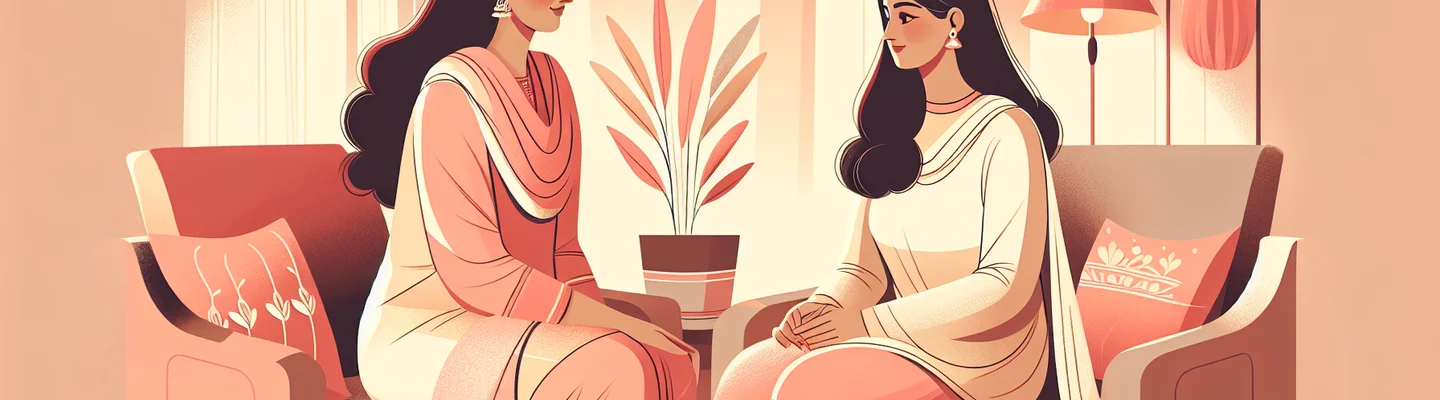
Your husband is the person who is closest to the daily reality of what you are going through, and he is often the one with the least information. Many men in India have heard the word menopause but have only the vaguest sense of what it actually means.
Start simple. You do not need a long conversation the first time. A statement like "I want to share something with you. I am going through perimenopause, which is the years leading up to menopause. It explains a lot of what has been happening with me lately, and I wanted you to know." That is enough to open the door.
Be specific about what you need. Husbands often want to help but have no idea how. Tell them. "I need you to understand that when I am irritable, it is often hormonal, not personal." Or "I need an hour of quiet in the evening." Or "I need you to handle bedtime routines twice a week so I can sleep earlier." Specific requests work better than vague ones.
Share resources where helpful. A short article. A book. A podcast episode. Many men learn well through reading or listening. Pick a resource that matches how he prefers to consume information.
Be patient with the learning curve. Most husbands will not get it right immediately. Some will say insensitive things at first. Some will retreat in confusion. Most, given time and information, will get there. Lead the conversation but allow it to take time.
If you have children, age appropriate honesty matters more than people realise.
For younger children, you do not need a detailed biology lesson. A simple framing works. "Mama is going through some changes that happen to women's bodies as they get older. It might mean I am tired sometimes or need a quiet moment. It is not because of anything you did."
For older children, particularly daughters, much more direct conversation is appropriate and welcome. Tell them what you are going through. Tell them what perimenopause is. Tell them when their grandmothers went through menopause. Tell them what you wish you had been told. You are not just managing your present, you are giving them a map for their future.
For sons, the same conversation is valuable in a different way. Sons who grow up understanding that women's bodies go through real changes, and that those changes deserve respect and support, become better partners, brothers, fathers, and colleagues. This is not a small thing.
This is often the hardest conversation, and it depends entirely on your family dynamic.
With your own mother, if she is alive and you have a close relationship, this can actually be one of the most healing conversations. Many mothers carry their own unprocessed experiences of menopause, and a daughter asking for their story can be deeply meaningful for both of you. Ask her what it was like. What helped her. What she wished she had known. The conversation can transform your relationship.
With in laws, the calculation is different. Some women have warm, open relationships with their in laws and can have these conversations naturally. Others have more formal or strained relationships where personal disclosure is not appropriate. Read your situation honestly. You do not owe everyone an explanation.
If you do speak with parents or in laws, keep it simple and matter of fact. "I am going through perimenopause. It is normal but it can be difficult. I appreciate your patience." That is enough.
This is often where the most relief comes from. Other women, particularly those in the same age range, are usually navigating something similar and have nobody to discuss it with.
Be the one who starts. The relief on women's faces when they realise they are not alone is something to behold. Mention casually that you have been having a tough time with sleep, or that you finally figured out the hot flashes are real. Watch what happens. Most likely, three other women will lean in with their own stories.
Build a small circle. You do not need many people. Two or three women you can text honestly when you are having a difficult day make all the difference.
Consider online communities. There are growing online communities of Indian women in midlife sharing experiences. They can be a useful supplement to in person friendships, particularly if your immediate circle is not having these conversations yet.

Sometimes you will share what you are going through and the response will be unhelpful. A husband who minimises it. A mother in law who says she went through it without complaining. A friend who suggests you are being dramatic. A doctor who brushes you off.
These responses are not your fault and they do not require you to apologise or retreat.
Have a few simple lines ready. "This is a real, recognised medical experience that affects most women in some form." Or "I am sharing this with you because I want your support, not your judgement." Or simply, "I am not asking for advice. I am telling you so you understand what is happening."
You do not have to convince everyone. You just need a few people who genuinely understand. The rest can come along over time, or not at all.
When you talk openly about what you are going through, you are doing something larger than managing your own experience. You are teaching the next generation, particularly your children and the younger women in your life, that women's bodies are not shameful, that midlife is a real phase that deserves attention, that knowledge of one's own body is a right not a privilege.
Your daughter will eventually go through this herself. Your son will eventually be a partner, possibly a husband, to a woman who goes through this. Your nieces and younger colleagues are watching how you talk about your body and your experiences. The norms you set now will shape what they expect from themselves and others for decades to come.
This is not a small responsibility. It is also not a heavy one, if you carry it lightly. Just talking honestly is enough.
Indian families have spent generations not talking about what happens to women's bodies. We are the first generation that genuinely has the chance to change that, one honest conversation at a time. None of these conversations need to be perfect. They just need to happen.
Your husband does not need a full education in endocrinology. He just needs to understand that what is happening to you is real and that you need his support. Your children do not need a biology lecture. They just need to know that mama is okay even when she is tired. Your friends do not need a medical opinion. They just need someone to start the conversation so they realise they can join in.
Across India, millions of women are silently going through this phase, surrounded by family who would support them if they only knew what was happening. At Pinkishe Foundation, we work every day to make sure that women in this country have access to honest health information and the language to share it. Five hundred rupees gives one girl a full year of menstrual health support and the body literacy she carries with her for life. These are the conversations that change generations.
If reading this article gave you the courage to have one of these conversations at home, perhaps you can help us start the same conversation in another home somewhere too.
Keep it simple. Tell him you are going through perimenopause, briefly explain what it is, and tell him specifically what kind of support you need. Most husbands want to help but do not know how. Specific requests work better than vague ones.
Yes, in age appropriate ways. Younger children need only basic reassurance. Older children, particularly daughters, benefit from direct conversation. Sons benefit from understanding too. These conversations help them be better adults.
You cannot convince everyone, and you do not have to. Identify the few people in your life who do understand and lean on them. Keep things simple and matter of fact with the rest. Their lack of understanding is their limitation, not your failure.
Breaking the silence about menopause at home is one of the most meaningful things any of us can do. It changes our own daily experience by bringing in support and understanding. And it teaches the next generation that women's bodies and experiences deserve to be spoken about openly, not hidden in shame. Start with one conversation, then another. The silence ends one home at a time.
Visit pinkishe.org to learn about our work for women across India, or support us so we can keep reaching more women who need honest information and the language to share it.
Just ₹500 gives one girl a full year of menstrual protection. Tax-deductible under Section 80G.
YOU CAN MAKE A DIFFERENCE
Just ₹500 gives one girl safe menstrual protection for an year.
Tax-deductible under Section 80G.
4,16,600+ women supported 34,50,000+ pads distributed
Join us

Priya S. donated ₹500 · 2 hrs ago
Rohit K. donated ₹1,500 · Yesterday
Meera T. donated ₹200 · 2 days ago
Sneha J. donated ₹500 · 3 days ago
Kavita D. donated ₹1,500 · 4 days ago


%20(2).webp)


%20(5).webp)
.webp)

%20(4).webp)
.png)
%20(5).webp)


%20(3).webp)
