Website under Maintenance. We regret any data inaccuracies. Thank you for your patience.





Pinkishe Foundation

4/5/2026
Ask ten Indian women when menopause is supposed to happen, and you will probably get ten different answers. Most will say something vague like "around 50" because that is the global figure floating around in popular conversation. The actual answer for Indian women is more specific, and a bit more interesting than that.
For Indian women, menopause typically arrives earlier than the global average. The average age in India is around 46 to 47, compared to 51 in Western countries. That is a difference of nearly five years. And almost nobody mentions this to us, even though it shifts how we should think about our health, our planning, and our bodies through our 40s.
If you are in your 40s and starting to wonder where you are on this timeline, this is a useful piece of information to have. So let us walk through it together.
There are a few honest reasons working together.
Genetics play a real role. Indian women, like women across South Asia, tend to enter menopause earlier than European or American women. This is not unusual or alarming. It is simply how our bodies are built, shaped by thousands of years of evolution in a particular part of the world.
Lifestyle and health factors also matter. Nutrition during childhood and adolescence, body weight, smoking, chronic stress, and overall health all influence the timing. Women who grew up with deficiencies, or who have lived through significant illness, often see menopause arrive earlier. Women who have undergone certain medical treatments, like chemotherapy or hysterectomy, may experience it even sooner.
There is also a hereditary pattern that is worth knowing. If your mother had menopause at 45, there is a reasonable chance yours will fall in a similar range. It is not exact, but it is a useful reference. Ask your mother. Ask your aunts. Ask your elder sisters if any have already been through it. Their stories are your best preview.
Menopause is not a single event that happens overnight. It unfolds in three distinct phases, and knowing them helps everything make more sense.
The first is perimenopause, which can begin anywhere from your late 30s to your mid 40s. This is when your hormones start fluctuating wildly and your cycle becomes irregular. Most of the symptoms women describe, hot flashes, mood changes, sleep disruption, brain fog, all begin in this phase. Perimenopause can last anywhere from two to ten years.
The second is menopause itself. This is technically just one moment, defined as the point when you have gone twelve full months without a period. The average Indian woman reaches this milestone around 46 or 47, though anywhere between 42 and 53 is considered within the normal range.
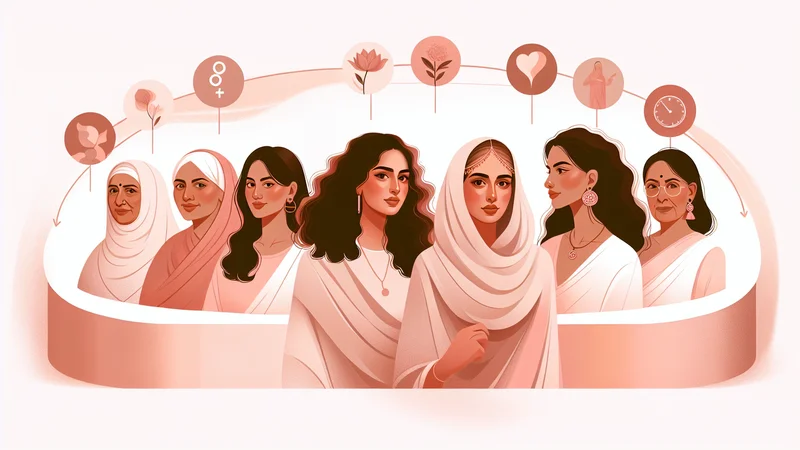
The third phase is postmenopause, which is the rest of your life after menopause is confirmed. By this stage, much of the hormonal turbulence has settled. Your body has adjusted to lower oestrogen levels. Many women report feeling more steady and clear in postmenopause than they did during perimenopause, which surprises everyone, including the women themselves.
So the full arc, from your first wonky cycle in your early 40s to a settled postmenopause, can span anywhere from five to fifteen years. That is a meaningful chunk of your adult life. Worth understanding properly.
If menopause arrives before age 45, it is considered early menopause. If it happens before 40, the medical term is premature menopause or premature ovarian insufficiency. Both are more common in India than people realise, and both deserve serious attention.
Early menopause can happen for many reasons. Sometimes it runs in the family. Sometimes it follows surgery, particularly hysterectomy or removal of the ovaries. Sometimes it is linked to autoimmune conditions, certain cancer treatments, or simply happens without an identifiable cause.
If you are in your late 30s or early 40s and your periods are becoming noticeably irregular, please do not assume you are too young for this conversation. You are not. Early menopause has real implications for bone health, heart health, and long term wellbeing, and the earlier it is identified, the better it can be managed.
This is not just curiosity or trivia. Knowing roughly when menopause is likely to arrive in your life helps you plan for what comes next. It changes how you think about your bone health in your 40s. It shapes decisions around hormone testing, supplements, exercise, and even fertility if that is still relevant for you.
Indian women today often delay marriage and childbearing into their 30s. If menopause arrives in your mid 40s, that gives you a different window to think about than someone planning around menopause at 51. This is information that should be part of every woman's health conversation, and yet it almost never is.
It also helps emotionally. Most women in perimenopause feel like their body has betrayed them. Knowing this is a normal phase that arrives at a normal age, with a roughly predictable course, makes the experience much easier to accept and navigate.
If you are in your 40s, start a basic health baseline. Get your bone density checked. Have your hormone levels measured, particularly FSH and oestrogen. Track your cycle and any new symptoms you notice. Pay attention to changes that feel different from anything you have experienced before.
Talk to your mother about her experience. When did she go through menopause? What were her symptoms like? Was anything particularly difficult about the process for her? You may learn things you never knew, and you will probably get a useful preview of what to expect for yourself.
Find a gynaecologist who specialises in midlife women's health. Not every gynae in India is comfortable with menopause care. The good ones are out there. Ask in your network, search online, request referrals. The right doctor makes everything easier.

There is something quietly powerful about being able to map the timeline of your own life. Generations of Indian women went through menopause without ever having a clear picture of what was happening or when it would end. They suffered in confusion, sometimes for years.
You do not have to. Just by reading this far, you are doing what your mother and grandmother were never given the chance to do. You are mapping your future with information.
Across India there are millions of women, in cities and villages, who still do not have access to even this basic understanding of their bodies. They cannot google. They cannot ask. They cannot find this article.
At Pinkishe Foundation, we work to change that, one community at a time. Five hundred rupees gives one girl a full year of menstrual health education and safe pads. Two hundred rupees covers her for three months. The information you have just read should not be a privilege. It should be every woman's birthright.
If this helped you, consider helping us reach her.
The average age for menopause in Indian women is around 46 to 47, which is earlier than the global average of 51. Anywhere between 42 and 53 falls within the normal range.
A combination of genetics and lifestyle factors. South Asian women tend genetically toward earlier menopause, and factors like nutrition, body weight, and overall health during reproductive years also play a role.
Yes, completely normal for Indian women. Menopause anywhere between 42 and 53 falls within the typical range. If it happens before 40, it is called premature menopause and is worth discussing with a specialist.
Menopause is not the end of anything important. It is a transition, like any other in a woman's life. The more clearly you can see it coming, the more peacefully you can live through it.
Indian women have spent generations going through this passage in silence and confusion. We are the first generation that gets to do it with information. Use that. Pass it on.
Visit pinkishe.org to learn about our work bringing menstrual health information and resources to girls and women across India. Or support us so we can reach the next girl who has nobody else to tell her.
Just ₹500 gives one girl a full year of menstrual protection. Tax-deductible under Section 80G.
YOU CAN MAKE A DIFFERENCE
Just ₹500 gives one girl safe menstrual protection for an year.
Tax-deductible under Section 80G.
4,16,600+ women supported 34,50,000+ pads distributed
Join us

Priya S. donated ₹500 · 2 hrs ago
Rohit K. donated ₹1,500 · Yesterday
Meera T. donated ₹200 · 2 days ago
Sneha J. donated ₹500 · 3 days ago
Kavita D. donated ₹1,500 · 4 days ago


%20(2).webp)


%20(3).webp)
%20(5).webp)

.webp)


%20(5).webp)

%20(4).webp)


.png)